Subterranean termite treatment in Atlanta requires deliberate mechanical adaptation to dense Piedmont red clay soils that trap sub-surface moisture against aging foundation lines. Historic heart-pine joists in Inman…
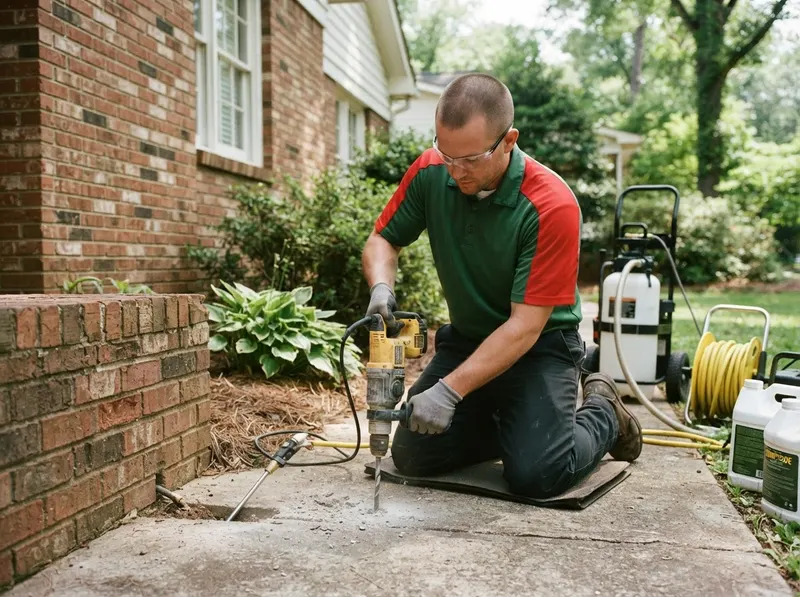
Subterranean termite treatment in Atlanta requires deliberate mechanical adaptation to dense Piedmont red clay soils that trap sub-surface moisture against aging foundation lines. Historic heart-pine joists in Inman Park Victorian framing, brick pier crawlspaces throughout Grant Park, and poured-concrete slab foundations in Midtown terrace levels present distinct penetration corridors for foraging worker termites. Termites construct shelter tubes out of clay, saliva, and fecal matter to traverse masonry foundations, moving invisibly behind finished drywall and sill plates. A thorough defense establishes a continuous subterranean barrier rather than relying on superficial spray treatments that leave hidden crawlspace channels exposed.
Property owners face a direct engineering decision between non-repellent liquid termiticide barriers and targeted sub-soil bait stations. Liquid termiticides bind directly to the soil particles within a 6-inch by 6-inch perimeter trench excavated along exterior foundation walls, providing continuous chemical protection that termites transfer back into the subterranean nest through grooming behavior. In contrast, discreet sub-soil baiting systems are installed every 10 to 15 feet around the perimeter dripline, offering an option where historic flagstone patios or thick concrete walkways in Buckhead or Virginia-Highland prevent trenching. While liquid barriers deliver immediate zone containment, bait systems require continuous monitoring schedules to intercept new subterranean migrations traveling inward from surrounding oak root systems.
Treatments follow a systematic execution protocol. 1. Technicians measure perimeter linear footage and map out structural wood-to-ground contact points across the basement or crawlspace footprint. 2. Technicians dig 6-inch trench lines around the exterior footprint or drill 0.5-inch holes spaced 12 inches apart through attached garage slabs and masonry steps. 3. Technicians inject EPA-registered non-repellent termiticide solutions at precise label volume rates of 4 gallons per 10 linear feet per foot of depth. 4. Drill holes are sealed with masonry hydraulic plugs, and crawlspace moisture sources are recorded to verify long-term soil stabilization.
Every job gets a firm, written price after a free on-site visit.
Tell us about your subterranean termite treatment job in Atlanta and we'll send a clear, written quote, usually the same day.
 Peachtree Falcon Pest Control